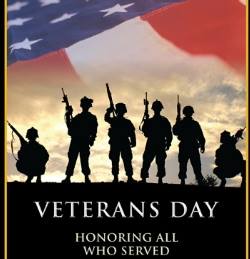
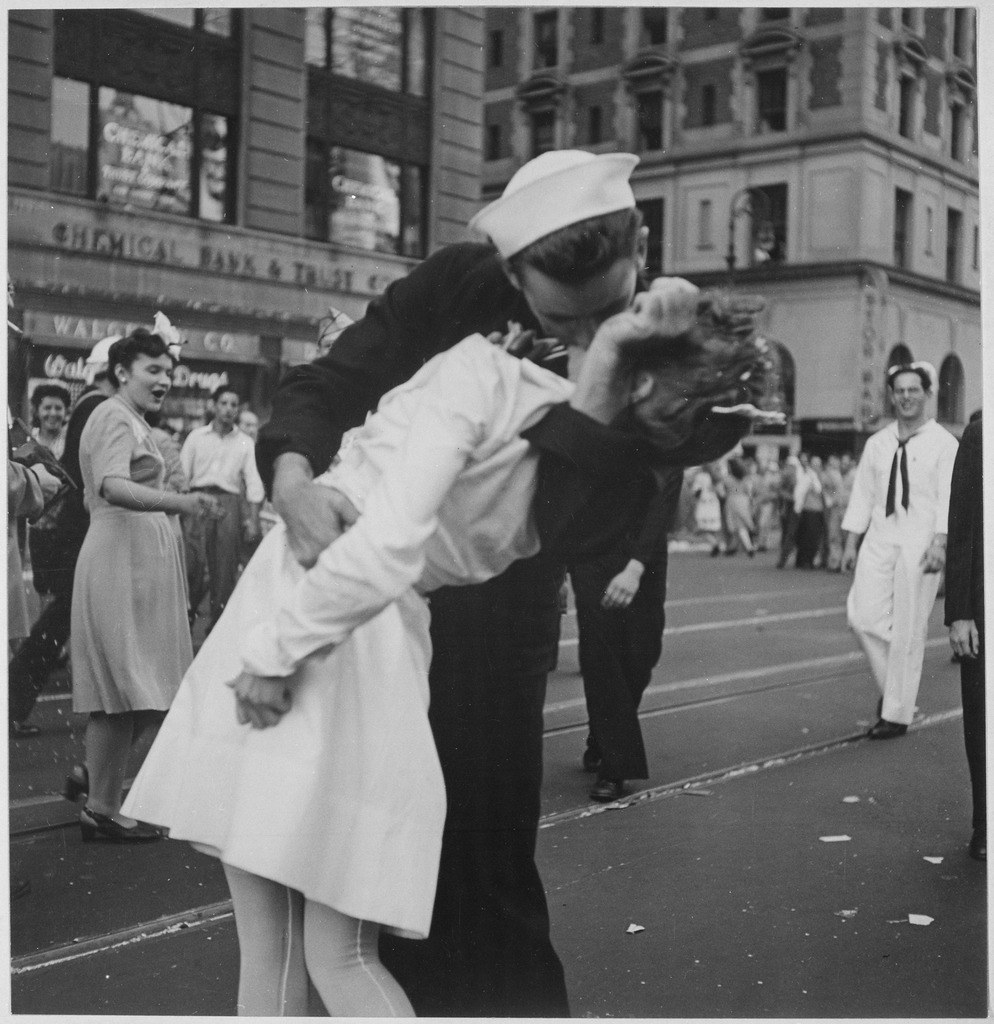
Veterans Day, November 11, 2020

by HB Auld, Jr.

In Flanders Fields

BY JOHN MCCRAE


In Flanders fields the poppies blow
Between the crosses, row on row,
    That mark our place; and in the sky
    The larks, still bravely singing, fly
Scarce heard amid the guns below.

We are the Dead. Short days ago
We lived, felt dawn, saw sunset glow,
    Loved and were loved, and now we lie,
        In Flanders fields.

Take up our quarrel with the foe:
To you from failing hands we throw
    The torch; be yours to hold it high.
    If ye break faith with us who die
We shall not sleep, though poppies grow
        In Flanders fields.


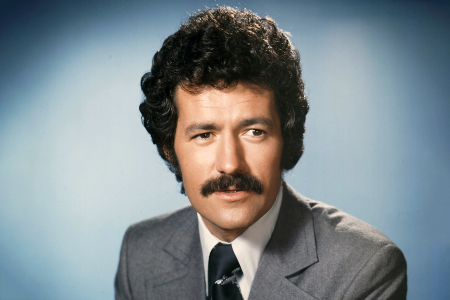
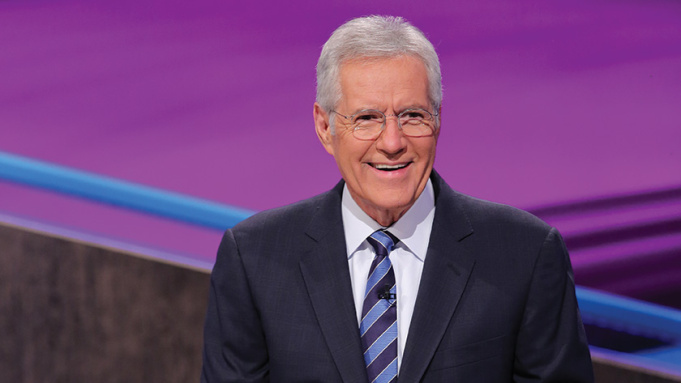
Jeopardy host Alex Trebek dies at 80

by HB Auld, Jr.

Beloved Jeopardy television program host Alex Trebek died this morning of pancreatic cancer at the age of 80.

Alex announced he suffered from Stage Four Pancreatic Cancer in March, 2019. He was surrounded by his wife, Jean, and his family when he died.

According to TMZ, Alex powered through for a full year — despite what he called “massive attacks of great depression that made me wonder if it was really worth fighting on” — because he said he realized giving up on life would be a betrayal to his wife, to God, and to other cancer patients.

God rest his soul and may he Rest In Peace.

Thank you, Alex, for more than 36 years of great Jeopardy programs, for your other entertainment programs before that one, and for showing us your dignity throughout your illness.

My Younger Sister is the Same Age as I Am, Again

by HB Auld, Jr.

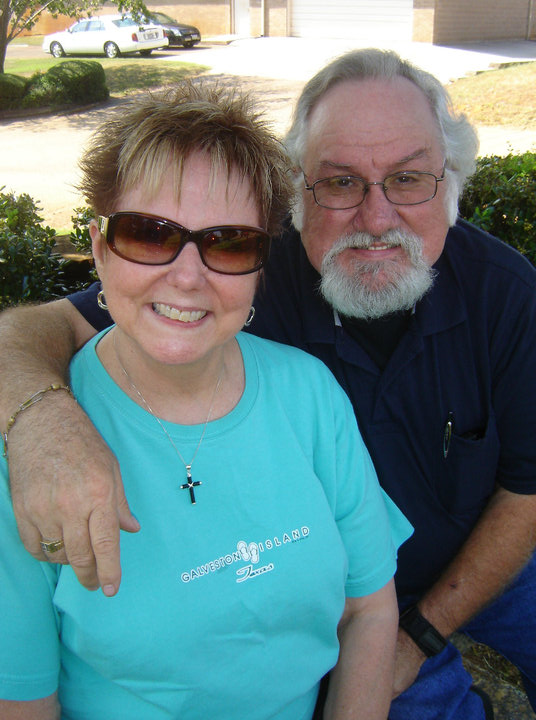
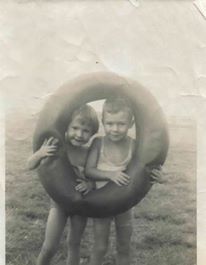
My sister, Jeri Lynn (Auld) Harness caught up with me yesterday and for these four days out of each year, we are the same age. She was born on November 1st, four days before my first birthday on November 5th.

We kid each other about being the same age every year during these four days. That makes us what is referred to as “Irish Twins,” two siblings born within the same year.

Happy birthday, Shugga, my sweet Little Sister, wife, grandmother, and great-grandmother. Be well and have a blessed year.

Amy Coney Barrett Becomes Newest Associate Justice

By HB Auld, Jr.

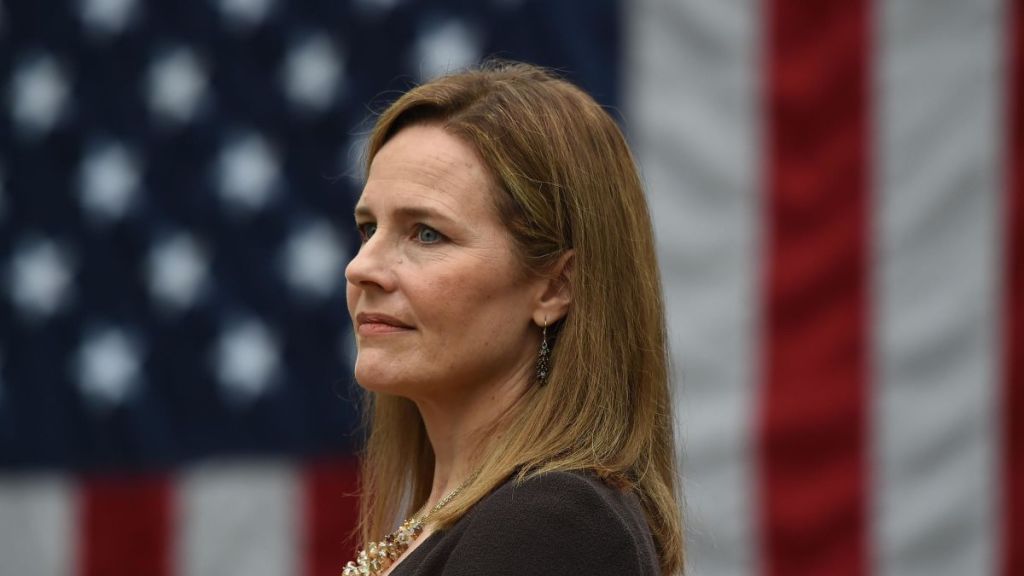
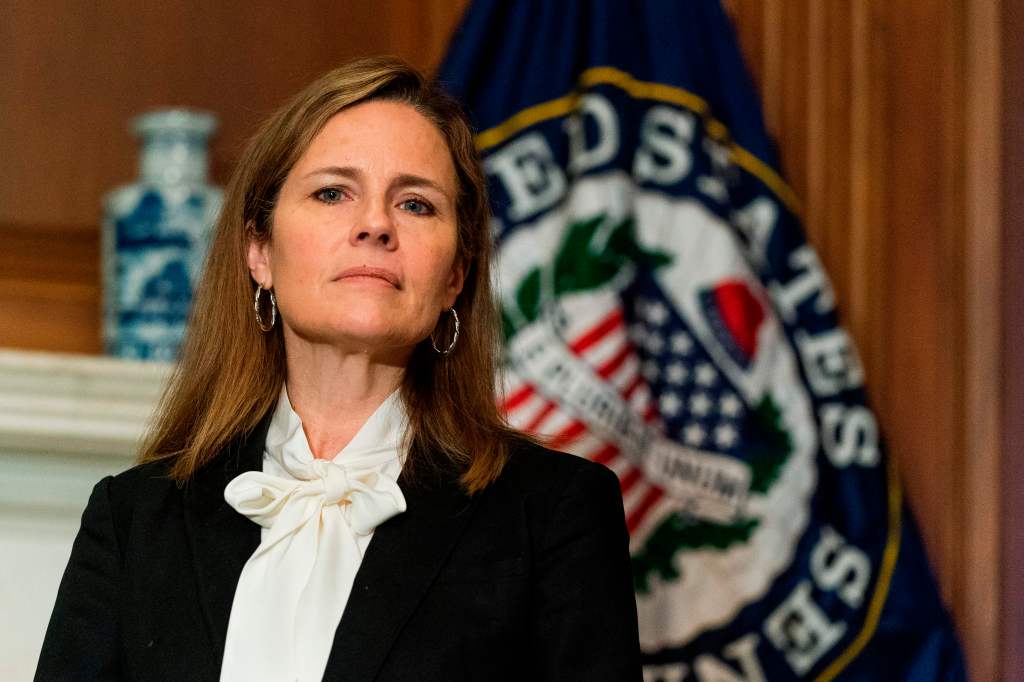
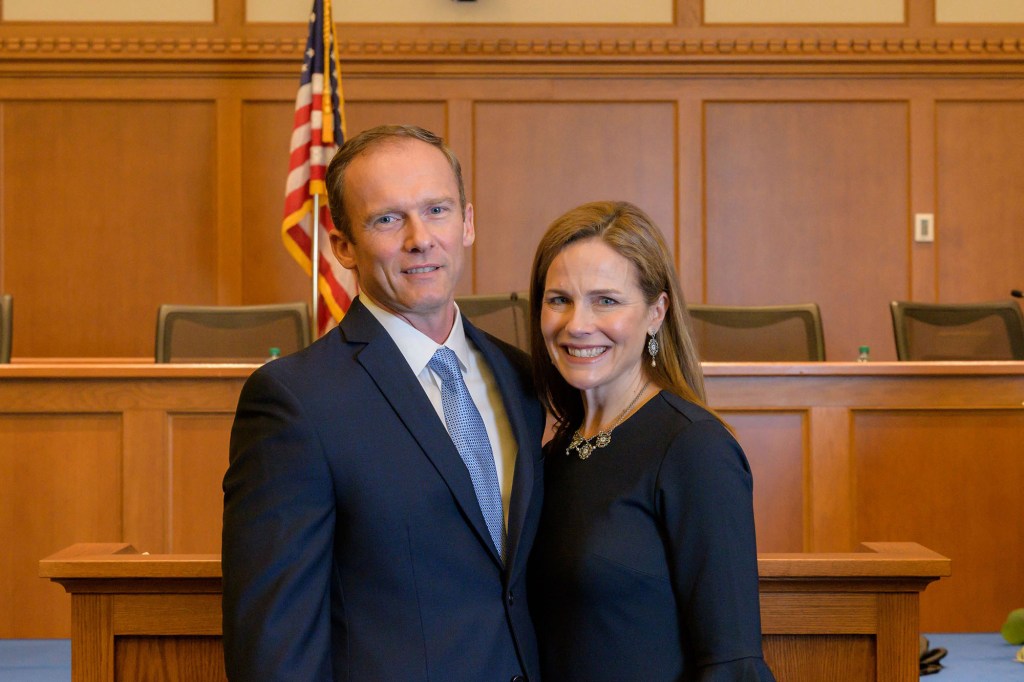
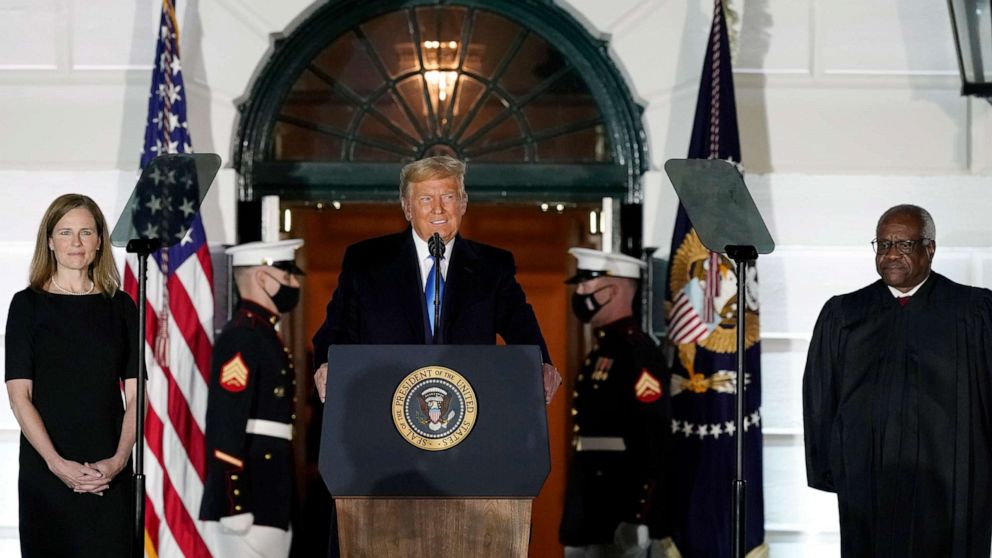
Judge Amy Coney Barrett was sworn in as the newest Associate Justice of the US Supreme Court tonight. Associate Justice Clarence Thomas, the longest-serving Justice on the current Court, administered the Oath of Office to Justice Barrett in front of her husband, Jesse, and a crowd of supporters in front of the White House tonight.

Justice Barrett will repeat the Oath of Office in a private ceremony Tuesday, October 27, 2020, at the Supreme Court. Court Chief Justice John Roberts will administer that private Oath.

Justice Barrett is known as an “originalist” in her defense of the US Constitution. She defines an originalist as: “Originalism is characterized by a commitment to two core principles. First, the meaning of the constitutional text is fixed at the time of its ratification. Second, the historical meaning of the text ‘has legal significance and is authoritative in most circumstances.'”

Justice Barrett ‘s resume contains a long list of accomplishments, including attending Rhodes College in Tennessee where she majored in English Literature and French, graduating first in her law class at Notre Dame University, one year of service as a law clerk for the late Supreme Court Associate Justice Antonin Scalia, fifteen years as a law professor at her alma mater at Notre Dame, and three years as a Judge on the US Court of Appeals for the Seventh Circuit.

The 48-year old jurist and her husband, Jesse Barrett, have seven children, including two children adopted from Haiti. Justice Barrett comes from a large family, herself. She is the eldest of seven children, with five sisters and one brother. Her family is devoutly Catholic. Her father has served as an Ordained Deacon for 38 years. She is of French descent and grew up outside of New Orleans, LA, in the suburb of Metairie.

Happy Birthday to the USS Constitution: Old Ironsides!

By Guest Author, Tara Ross

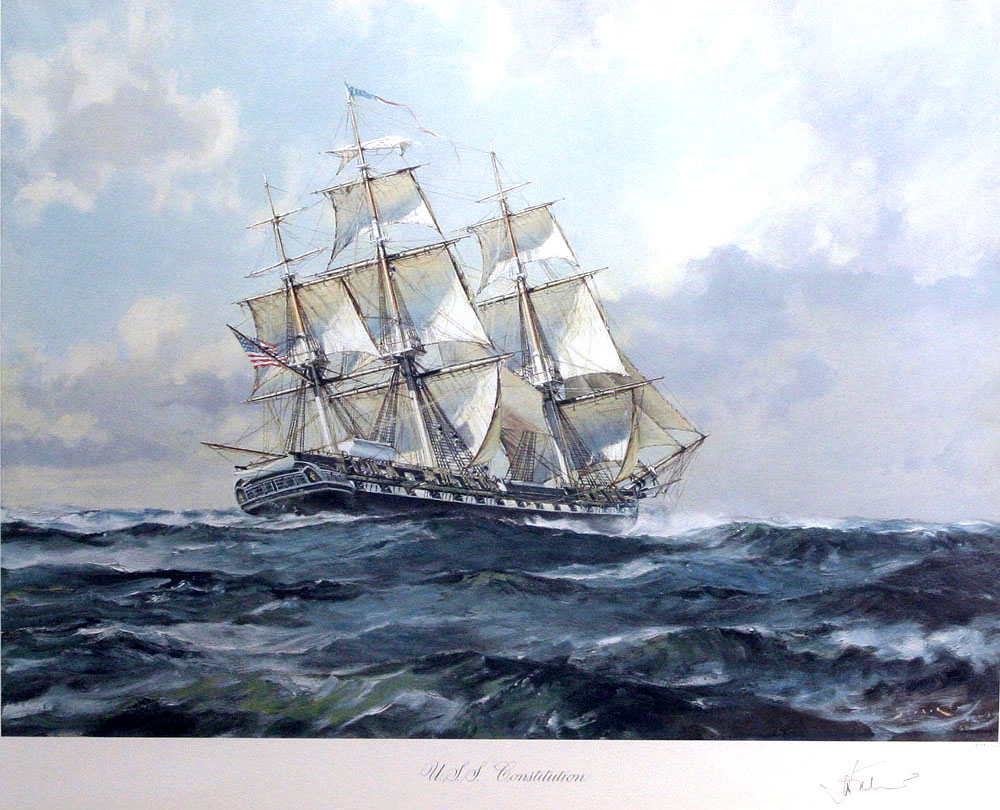
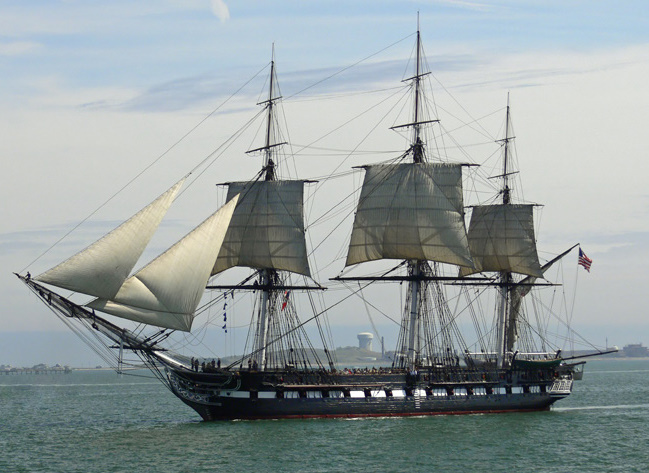
On this day in 1797, Old Ironsides is launched!

“Old Ironsides” is the nickname that was given to the USS Constitution, one of the first six frigates built for the U.S. Navy during the early years of our country. Initially, the frigate was used in the Quasi War with France and the Barbary Wars, but it is perhaps most famous for its performance during the War of 1812.

USS Constitution defeated four English warships.

A former captain of USS Constitution, Tyrone G. Martin, later wrote a history of the ship. He describes the effect of these victories: “The losses suffered by the Royal Navy were no more than pinpricks to that great fleet: They neither impaired its battle readiness nor disrupted the blockade of American ports. . . . What Constitution and her sister [ship] did accomplish was to uplift American morale spectacularly and, in the process, end forever the myth that the Royal Navy was invincible.”

The ship earned its nickname during a battle fought on August 19, 1812.

On that day, Constitution encountered HMS Guerriere off the coast of Nova Scotia. The two ships got within about 50 yards of each other and began firing their cannons. Constitution was causing great damage to the British ship, even as the British cannon balls were bouncing off the hard oak sides of Constitution. One of the American crewmen saw what was happening and was heard to yell: “Huzza! Her sides are made of iron!”

The nickname “Old Ironsides” was born!

The British surrendered roughly one hour after the attack began. Guerriere was badly damaged and had to be sunk after the battle. The British captain later reported: “The Guerriere was so cut up, that all attempts to get her in would have been useless. As soon as the wounded were got out of her, they set her on fire; and I feel it my duty to state that the conduct of [American] Captain Hull and his Officers to our Men has been that of a brave Enemy.”

If the victory provided a psychological boost to Americans, it seems that it was equally demoralizing to the British. The London Times mournfully reported: “Never before in the history of the world did an English frigate strike to an American.”

Old Ironsides has been preserved and can still be seen at the Charlestown Navy Yard in Massachusetts. It’s well worth the visit.


If you enjoy these history posts, please see the note below.

Gentle reminder: History posts are copyright © 2013-2020 by Tara Ross. I appreciate it when you use the shar e feature instead of cutting/pasting.#TDIH#OTD#History#USHistory#liberty#freedom#ShareTheHistory

EDITOR’S NOTE: Guest author, Tara Ross, is a mother, wife, writer, and retired lawyer. She is the author of The Indispensable Electoral College: How the Founders’ Plan Saves Our Country from Mob Rule,Enlightened Democracy: The Case for the Electoral College, co-author of Under God: George Washington and the Question of Church and State (with Joseph C. Smith, Jr.), & We Elect A President: The Story of our Electoral College. She is a constitutionalist, but with a definite libertarian streak! Stay tuned here for updates on pretty much anything to do with the Electoral College, George Washington, & our wonderfully rich American heritage.

Columbus Day: October 12, 2020

By Guest Author: Tara Ross

During this week in 1492, Christopher Columbus lands in the New World. Exactly 300 years later, New York City would hold the first Columbus Day celebration. More unofficial celebrations would follow, and the day finally became a federal holiday in the 1930s.

Since then, the holiday has become controversial—to say the least. Some people want to replace his holiday with an “Indigenous Peoples’ Day.” Others want to tear down Columbus statutes, labeling them a “symbol of hate.” But do you know how and why we started celebrating Columbus Day in the first place?

It’s impossible to understand Columbus Day unless you first step into the shoes of our Founders.

During America’s early years, the country was looking for heroes. We’d just cut ourselves off from England and had thus lost much of that heritage. Obviously, we had heroes such as George Washington, but Americans wanted other heroes, too. Christopher Columbus was a natural choice. The Italian explorer had risked everything to make a dangerous trip across the Atlantic. He had no idea that he would find an entirely new continent, of course. He was on a mission to find a quicker route from Europe to Asia.

He never found Asia. Instead, he landed in the New World on October 12, 1492. He would make four voyages to the New World before his death in 1506.

Perhaps it is unsurprising that Columbus came to be admired by so many after the American Revolution? His daring spirit, sense of adventure, and his willingness to put everything on the line were understandably appealing to a generation that had just fought—and won—a war against the mighty British army and navy.

Over time, Columbus grew into an American icon. His name is all around us, although you’ve probably never really thought about it. Columbia University is named for him, as is South Carolina’s capital. The Knights of Columbus adopted the name in remembrance of Columbus’s Catholic roots. Perhaps most notably, the District of Columbia—Washington, D.C.—bears his name.

It’s worth noting that those in the Italian community became especially proud of Columbus over the years. They were immigrants who hadn’t always been treated well. But celebrations of Columbus became an opportunity, one historian writes, “for reminding Americans of the indissoluble and everlasting bonds uniting American and Italian histories.”

Thus, to many people, the holiday took on a pro-immigrant meaning as well.

Obviously, Columbus was far from perfect, and modern Americans will debate the pros and cons of remembering his legacy. But perhaps it would help the dialogue to remember just what it was that our ancestors admired about him in the first place.

Ronald Reagan expressed this particular sentiment the best: “[Columbus] was a dreamer, a man of vision and courage, a man filled with hope for the future and with the determination to cast off for the unknown and sail into uncharted seas for the joy of finding whatever was there. Put it all together and you might say that Columbus was the inventor of the American dream.”


Gentle reminder: History posts are copyright © 2013-2020 by Tara Ross. I appreciate it when you use the shar e feature instead of cutting/pasting. #TDIH#OTD#History#USHistory#liberty#freedom#ShareTheHistory

EDITOR’S NOTE: Guest author, Tara Ross, is a mother, wife, writer, and retired lawyer. She is the author of The Indispensable Electoral College: How the Founders’ Plan Saves Our Country from Mob Rule,Enlightened Democracy: The Case for the Electoral College, co-author of Under God: George Washington and the Question of Church and State (with Joseph C. Smith, Jr.), & We Elect A President: The Story of our Electoral College. She is a constitutionalist, but with a definite libertarian streak! Stay tuned here for updates on pretty much anything to do with the Electoral College, George Washington, & our wonderfully rich American heritage.


Texas Revolution Began 185 Years Ago Today

By Tara Ross, Guest Author

On this day (October 2nd) in 1835, the Texas Revolution begins! Did you know that the first battle was fought because Texans decided that the Mexicans would have to pull an old, small cannon out of their cold, dead hands?

Does that fact, alone, explain my home state?!

The Texas Revolution wasn’t fought entirely over one old cannon, of course. That cannon was just the straw that broke the camel’s back, prompting a skirmish that came to be known as the Battle of Gonzales.

In 1835, Texans (or “Texians”) were concerned about the increasingly dictatorial Mexican government and its army. But the town of Gonzales found itself in the crossfire for a rather unexpected reason. It possessed one small cannon that had come from San Antonio de Béxar in 1831. Some thought the cannon was loaned, others thought it had been given. Either way, Gonzales felt that it needed the cannon to scare off local Indian tribes.

As tensions between the Mexican government and the Texians escalated, the Mexicans decided that Gonzales could not keep its cannon anymore. The given reason was that the cannon had been given only as a loan. But perhaps the real reason is that the government wanted to disarm citizens? Either way, town officials were notified that the cannon must be returned.

The alcalde, or mayor, of Gonzales called a town meeting and a vote was taken. All but three people agreed: Gonzales should keep its cannon!

Nevertheless, Mexican commander Francisco de Castañeda was sent to retrieve the cannon.

The Mexican force reached the Guadalupe River on September 29, but then it got stuck. Recent rains had made the river difficult to cross. Complicating matters, Texians had taken all the boats from Castañeda’s side of the river. Eighteen Texians were now guarding the river on the other side. In the meantime, Gonzales was calling for help from nearby towns. Its citizens buried the cannon in a nearby peach orchard.

Come hell or high water, they were not giving up that cannon!

The Texians managed to stall for a while. Castañeda wanted to talk, but the Texians noted that the talks were more properly held with the alcalde, Andrew Ponton. (Surprise, surprise. He wasn’t there.) Even when the Texians did engage in talks, they just shouted across the river at Castañeda. At one point, a single Mexican was allowed to swim back and forth with messages.

What a scene! Naturally, the delay mostly ensured that the Texians got reinforcements.

The stalemate continued until October 1, when Castañeda moved his men a few miles upriver. By now, the Texians were getting tired of the situation. They dug up the cannon and created shrapnel from anything they could find. They hauled the cannon across the river and approached the Mexican camp early on October 2. A thick fog hid them from view.

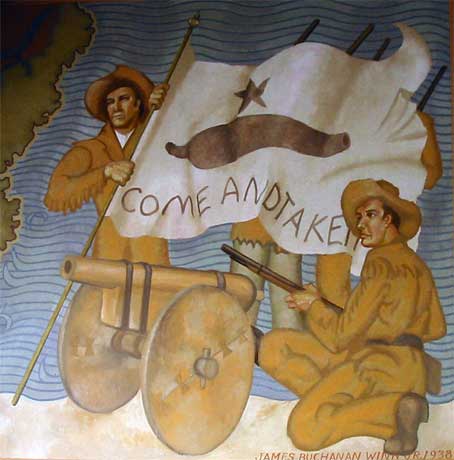
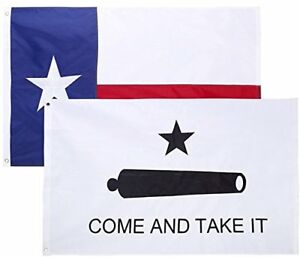
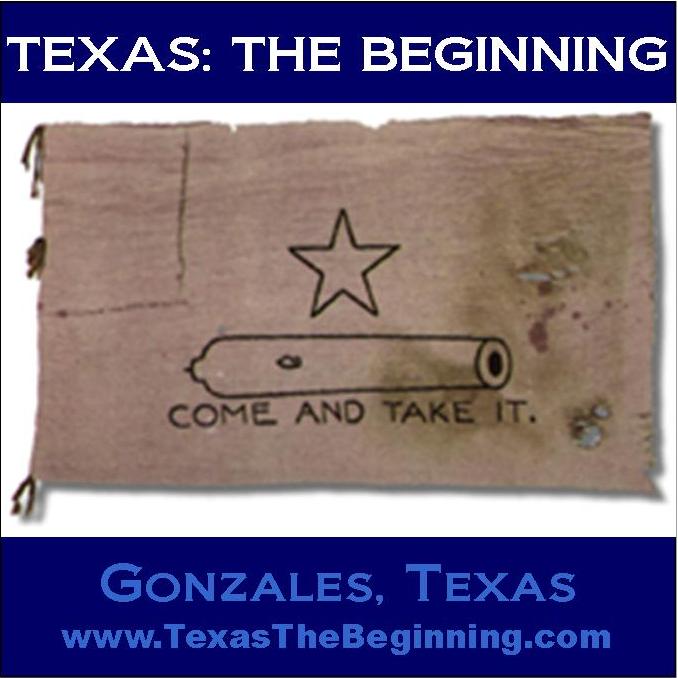
A few shots were exchanged during the early morning hours, but the more serious fighting began after sunrise. Naturally, the controversial cannon was brought into battle. The Texians had created a white flag, which waved proudly over the cannon.

You guessed it. The flag bore the words: “Come and Take It.”

The fighting itself was more of a brief skirmish than a true battle. In the end, Castañeda quickly retreated because he thought his orders required him to do so before the conflict escalated into war. His retreat came too late. The Texas Revolution was on.


Gentle reminder: History posts are copyright © 2013-2020 by Tara Ross. I appreciate it when you use the share feature instead of cutting/pasting.#TDIH#OTD#History#USHistory#liberty#freedom#ShareTheHistory

Guest author, Tara Ross, is a mother, wife, writer, and retired lawyer. She is the author of The Indispensable Electoral College: How the Founders’ Plan Saves Our Country from Mob Rule,Enlightened Democracy: The Case for the Electoral College, co-author of Under God: George Washington and the Question of Church and State (with Joseph C. Smith, Jr.), & We Elect A President: The Story of our Electoral College. She is a constitutionalist, but with a definite libertarian streak! Stay tuned here for updates on pretty much anything to do with the Electoral College, George Washington, & our wonderfully rich American heritage.

75th Anniversary of the Surrender of Japan, Ending WWII

by HB Auld, Jr.

Today is the 75th anniversary of V-J Day, the day remembered as the Victory over Japan day and the effective end of World War II. War would not “officially” end until the Treaty of San Francisco, signed almost seven years later on April 28, 1952.

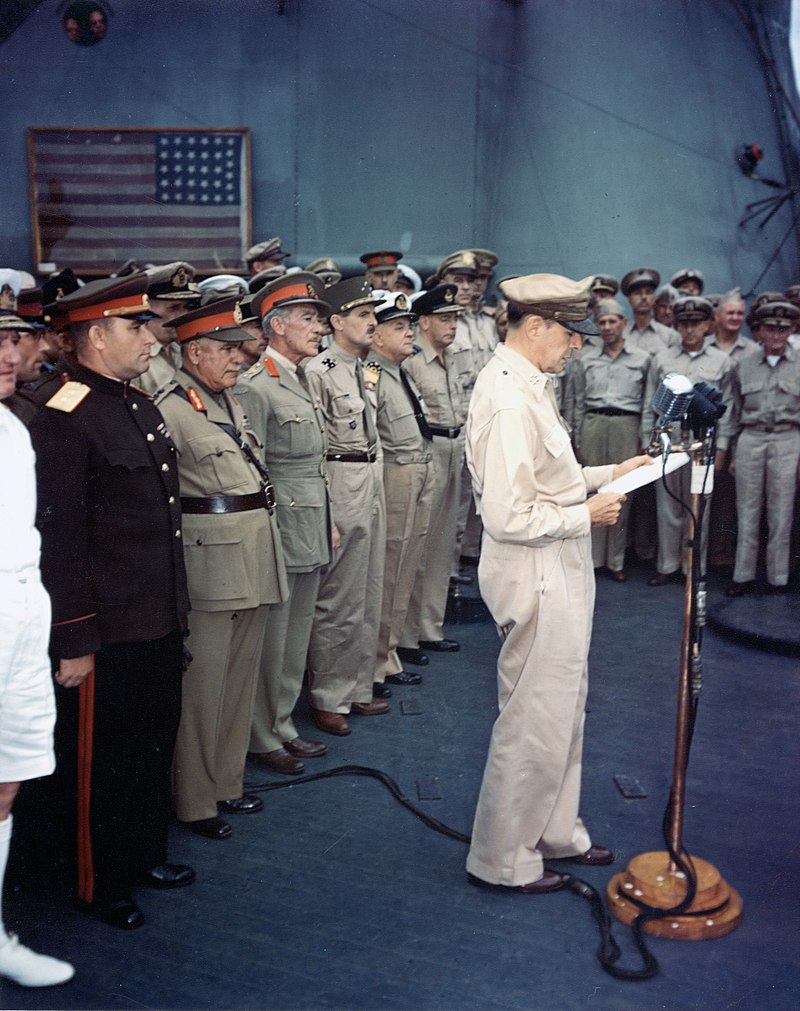
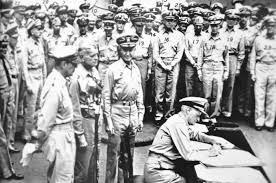
On September 2, 1945, members of the Supreme Allied Forces and the Government of Japan gathered on the teak deck of the USS MISSOURI (BB 63) to sign the formal declaration of surrender by the Japanese Empire. Hostilities leading to the United States’ entrance into World War II had begun almost four years earlier with a surprise attack on naval forces at Pearl Harbor, HI. Now, the “Rising Sun” empire would cease the fighting in the Pacific and China, with the primary condition of surrender being the preservation of the life of Japanese Emperor Hirohito.

Japanese Foreign Minister Shigemitsu signed for the Japanese government, while Japanese General Umezu signed for the Japanese armed forces. General of the Armies Douglas MacArthur and Navy Fleet Admiral Chester W. Nimitz signed for the United States. US Forces officers dressed in their daily khaki work uniforms for the auspicious ceremony. MacArthur is said to have ordered that he and his men would wear that working uniform, implying that this was just another “day at the office.” On the bulkhead behind the signatories that day was the “Perry Flag,” the US flag that flew over USS POWHATAN commanded by Commodore Matthew C. Perry on the first of his two expeditions to Japan in 1853, forcing the Japanese to open their country to trade with America.

That Perry flag was retrieved from the US Naval Academy in Annapolis, MD, especially for the ceremony. Admiral Bull Halsey wanted the flag for the ceremony, so a young naval officer, LT. John K. Bremyer, was tasked with rushing it 9,000 miles in record time from Annapolis to the Pacific. He was told to “get there any way you can” and that he did, hitching rides and going without sleep and sometimes meals as he traveled on his mission. He carried the flag in a box inside a courier bag and he slept with it, ate with it, even carried it to the bathroom with him, never letting it out of his sight. He held a Top Secret Clearance and was a member of the elite Courier Force whose job it was to ferry documents in military wartime. God bless LT John K. Bremyer.

My dad, HB Auld, Sr., fought in the Pacific in New Guinea; my father-in-law, JB Kattes, served in Alaska; and my uncle, Ross Wilton Hargis, was a pilot in Germany…all during World War II. Truly, they were members of The Greatest Generation.


Today is the 56th Anniversary of the Capture of the First Prisoner of War in Viet Nam

This slideshow requires JavaScript.

by Tara Ross, Guest Author

On this day in 1964, a U.S. Navy pilot arrives at the soon-to-be-infamous “Hanoi Hilton.” LTJG Everett Alvarez, Jr. would spend a stunning 3,113 days in captivity, making him one of America’s longest-held POWs.

Alvarez’s troubles began on August 5. His plane took a hit during a bombing run, and he was forced to bail out. Mere minutes later, he was captured by Vietnamese fishermen.

Alvarez found himself in a rather tricky situation. Was he a prisoner-of-war with all the protections of that status? The North Vietnamese claimed that he was only a common criminal. (War had not been declared.) Similarly, how should he answer questions? At first, Alvarez gave only his name, rank, and serial number. But he soon realized that Vietnamese authorities had information obtained from the American media. How did that change what he could or couldn’t say?

For months, Alvarez had nothing to rely upon except his own wits. There wasn’t even another American POW around. He was barely surviving in a small cell on a starvation diet.

“Sometimes I lifted the cover off a plate and found a chicken head floating in grease,” he wrote, “or in a slimy stew or soup smelling of drainwater. At other times an animal hoof . . . . More than once a blackbird lay feet up on the plate, its head and feathers intact and the eyes open.”

Alvarez implemented strategies to sustain himself. He scratched a cross into a wall and hosted his own Catholic Mass. He etched the passage of time on walls. He did complex math problems and played chess against himself, just to keep his brain working. He had daily cleaning rituals, which (sort of) warded off the cat-sized rats that roamed around.

Other POWs began to arrive in 1965.

Their arrival made Alvarez’s life better—and worse. On one hand, he had companionship. The men developed a tap code that worked through walls. Their communications system, Alvarez would say, “became our lifeline . . . . It fueled our morale and stiffened our backbone. Above all, it kept us informed . . . . To be forewarned was to be forearmed.”

On the other hand, interrogations got a lot worse.

The North Vietnamese wanted letters and recordings for propaganda purposes. Americans were tortured if they refused to cooperate. On one occasion, Alvarez was told to write an apology. His arms were contorted and painfully bound until he finally complied. “For the first time in my life,” he later wrote, “I felt sheer hatred . . . . It took a few hours before I could hold the pencil and when I did, my writing looked like a drunkard’s scrawl. . . . I took pains to misspell words to make the confession as phony as possible.”

The arm torture left the skin on Alvarez’s hands deadened and black. Natural color didn’t return for two years.

On another occasion, Americans were marched through a frenzied crowd. They’d been tethered to each other, defenseless, as the mob madly beat and kicked them. “Our emaciated bodies, lacking nutrition, sunlight and exercise for so long, were ill-equipped to withstand this kind of ordeal,” Alvarez concluded.

The treatment of prisoners improved, but not until after Ho Chi Minh died in 1969. Finally, in 1973, the POWs were released.

Alvarez had been a captive since the very beginning—but he’d also been a pillar of strength for everyone else. “[A]ll the POWs, looked up to Ev,” one said. “He was one of those optimists who always thought we would get out the next day.”

Unfortunately, homecomings weren’t always so rosy. For Alvarez, the difficult news concerned his wife. During his absence, she obtained a divorce—and a baby with a new husband.

Fortunately, this hero’s story has a happy ending: Alvarez remarried, earned graduate degrees, and founded a wildly successful company.


Author’s Note: If you enjoy these history posts, please see my note below.

Gentle reminder: History posts are copyright © 2013-2020 by Tara Ross. I appreciate it when you use the share feature instead of cutting/pasting.

#TDIH#OTD#History#USHistory#liberty#freedom#ShareTheHistory

Guest author, Tara Ross, is a mother, wife, writer, and retired lawyer. She is the author of The Indispensable Electoral College: How the Founders’ Plan Saves Our Country from Mob Rule,Enlightened Democracy: The Case for the Electoral College, co-author of Under God: George Washington and the Question of Church and State (with Joseph C. Smith, Jr.), & We Elect A President: The Story of our Electoral College. She is a constitutionalist, but with a definite libertarian streak! Stay tuned here for updates on pretty much anything to do with the Electoral College, George Washington, & our wonderfully rich American heritage.


The 75th Anniversary of the Bombing of Hiroshima, Japan

By Guest Author, Tara Ross

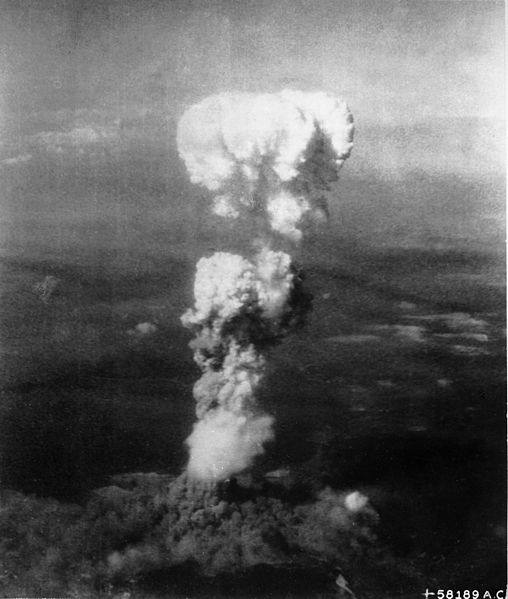
On this day in 1945, Americans drop an atomic bomb on the Japanese city of Hiroshima. The bombing came not too long after Japan had rejected a final opportunity to surrender.

The so-called Potsdam Declaration was issued through a combined statement of the United States, Great Britain, and China.

“The time has come,” these Allies declared, “for Japan to decide whether she will continue to be controlled by those self-willed militaristic advisers whose unintelligent calculations have brought the Empire of Japan to the threshold of annihilation, or whether she will follow the path of reason.”

Unconditional surrender was necessary. The alternative was “prompt and utter destruction.”

Japan rejected the ultimatum. Presumably, no one in Japan really knew what was coming. But you have to wonder whether anyone in America truly understood what was coming, either?

Captain William Parsons of the Manhattan Project briefed the crew of the Enola Gay (and others) before they departed on their historic mission: “The bomb you are going to drop,” he told them, “is something new in the history of warfare. It is the most destructive weapon ever produced. We think it will knock out everything within a three mile area.”

Well, yes, it did. But it also shattered glass in suburbs that were twelve miles away from the detonation site.

Later that day, President Harry S. Truman made a statement:

“The Japanese began the war from the air at Pearl Harbor. . . . We are now prepared to obliterate . . . every productive enterprise the Japanese have above ground in any city,” he stated. “We shall destroy their docks, their factories, and their communications. Let there be no mistake; we shall completely destroy Japan’s power to make war.”

Unfortunately, the Japanese did not surrender that day. A second bomb would be dropped on Nagasaki mere days later.

It was a hard day in world history, but it was also the beginning of the end of World War II.


History posts are copyright © 2013-2020 by Tara Ross. I appreciate it when you use the share feature instead of cutting/pasting. #TDIH#OTD#History#USHistory#liberty#freedom#ShareTheHistory

Guest author, Tara Ross, is a mother, wife, writer, and retired lawyer. She is the author of The Indispensable Electoral College: How the Founders’ Plan Saves Our Country from Mob Rule,Enlightened Democracy: The Case for the Electoral College, co-author of Under God: George Washington and the Question of Church and State (with Joseph C. Smith, Jr.), & We Elect A President: The Story of our Electoral College. She is a constitutionalist, but with a definite libertarian streak! Stay tuned here for updates on pretty much anything to do with the Electoral College, George Washington, & our wonderfully rich American heritage.