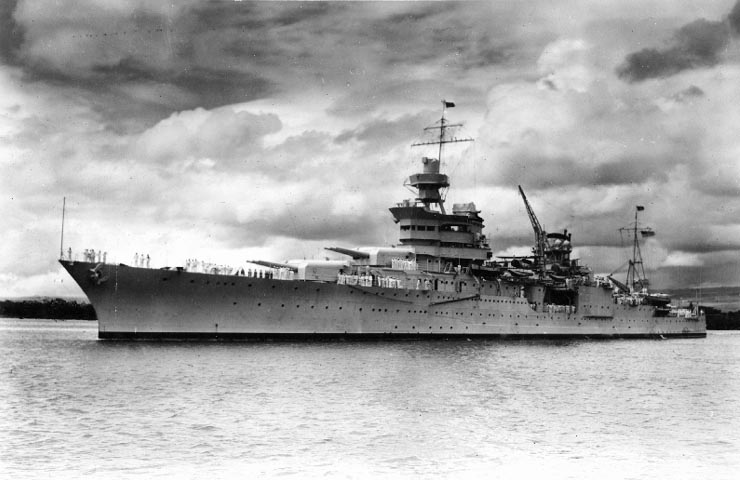
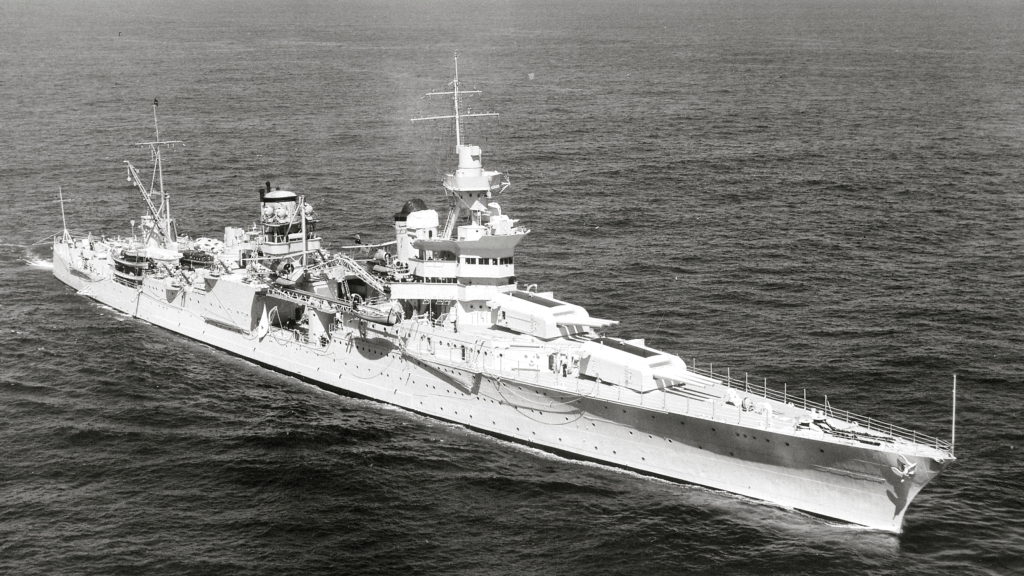
Today is a momentous day in the US Navy. It was on this day, August 3, 1945, that the last of the survivors of the sinking of the USS INDIANAPOLIS (CA 35), were pulled from the waters of the Pacific Ocean. They had floated there since the sinking of their ship, four days before on July 30, 1945, by a Japanese submarine.
The INDIANAPOLIS had been on a secret mission to deliver the parts for Little Boy, the first atomic bomb, to Tinian Island in the Pacific Ocean. The bomb would be dropped on August 6, 1945, on Hiroshima, Japan, leading to the unconditional surrender of the Japanese and the end of World War II.
After delivering the bomb parts, the ship departed for Guam and then on to Leyte Gulf in the Philippines, but was sunk en route. Of the 1,200 Sailors aboard the INDIANAPOLIS, about 900 survived the initial torpedoes and went into the water. Of those 900 men only 316 Sailors would survive the next four days, floating in the shark-infested waters of the Pacific before being rescued.
Here is Texas historian and author Tara Ross’ account of the rescue of these brave men as the last survivors are pulled from the water at dusk on August 3, 1945. May they all Rest In Peace.
*************
By Tara Ross (c)
On this day in 1945, the last survivors of the USS Indianapolis are pulled from the Pacific Ocean. They’d been there since a Japanese submarine had torpedoed and sunk Indianapolis on July 30.
They had just finished delivering parts for the Little Boy atomic bomb to American bombers! Now, because of communication gaffes, their ship was missing, but no one knew it. (See July 29 history post.)
Survivors were waiting for a rescue that was not coming.
The men were floating in small groups, strewn out across the last miles of Indianapolis’s journey. Survivors were covered in oil. Some were wounded. The Chief Medical Officer, Dr. Haynes, tried to care for his boys as best he could, but he knew some would not make it. Some hadn’t even survived the initial disaster.
As dead men were found in the water, Haynes later reported, “[w]e would then laboriously take off their life jacket and give it to men who didn’t have jackets. In the beginning I took off their dogtags, said The Lord’s Prayer, and let them go. Eventually, I got such an armful of dogtags I couldn’t hold them any longer. Even today, when I try to say The Lord’s Prayer or hear it, I simply lose it.”
Shark attacks were another problem. “They were continually there, mostly feeding off the dead bodies,” survivor Loel Cox later reported. But then the sharks began attacking men who were still alive. “We were losing three or four each night and day,” Cox said. “You were constantly in fear because you’d see ‘em all the time. Every few minutes you’d see their fins—a dozen to two dozen fins in the water.”
As the days wore on, the men became dehydrated. Some of them began to hallucinate. “[T]hey were goin bezerk,” survivor Woody Eugene James later testified. “They’d tell you big stories about the Indianapolis is not sunk, its’ just right there under the surface. I was just down there and had a drink of water . . . .” At other times, the hallucinations caused hysteria and fighting. Haynes spoke of men who would think “[t]here’s a Jap here and he’s trying to kill me.’ And then everybody started to fight. They were totally out of their minds.”
When help finally arrived, it was completely by chance.
Lt. Chuck Gwinn happened to be patrolling the area from the air, looking for Japanese submarines. He saw an oil slick! He thought perhaps it was a disabled Japanese submarine, so he prepared for a bombing run. As he got closer, he realized that there were people in the water. They needed help.
He still didn’t know if these people were friend or foe, but he began dropping life vests out of his plane. He radioed a message back to his base. It was then 11:25 a.m. on August 2.
The ordeal was far from over. Official rescue efforts were beginning, but it was a slow process.
Fortunately, a quick-thinking pilot with access to an amphibious plane heard one of Gwinn’s radio messages. Acting on his own initiative, Lt. Adrian Marks took off for Gwinn’s location. When he and his crew arrived hours later, he could see sharks circling in the water. The crew watched as multiple men were attacked, right in front of their eyes. They had to act!
Marks decided to act against standing orders. He would attempt a dangerous open sea landing. He knew that his plane could capsize, but he had to try.
Thankfully, he made it, and his crew began pulling survivors out of the water. They even tied survivors to the plane’s wings so they could get more people aboard! By nightfall, Marks had rescued 56 men from the water.
The first rescue ship arrived hours later, just before midnight.
The last men wouldn’t be found and pulled from the water until dusk on August 3. These men had been in the water for 112 hours, and they’d drifted more than 120 miles from Indianapolis’s original location.
The Little Boy bomb would be dropped on Hiroshima only 3 days later. Most of the heroes aboard Indianapolis would never know that they helped bring an end to World War II.
————-
If you enjoy these history posts, please know that it is important to LIKE, SHARE & COMMENT. This site’s algorithm will weed these posts out of your newsfeed if you do not interact with them. (I don’t make the rules! Just following them.)  😉
😉
Gentle reminder: History posts are copyright © 2013-2018 by Tara Ross. I appreciate it when you use the Facebook “share” feature instead of cutting/pasting.
Permalink: http://www.taraross.com/2018/08/tdih-uss-indianapolis-rescue
#TDIH #OTD #AmericanHistory #USHistory #liberty #freedom#ShareTheHistory
*************
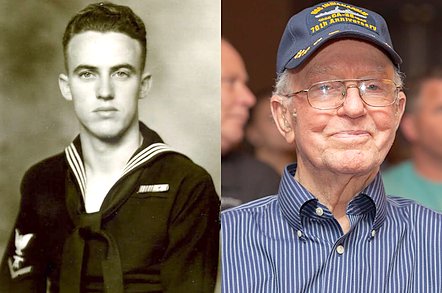
Editor’s Note: I was privileged to know one of these survivors: the late LT (Junior Grade) Charles McKissick. Mr. McKissick was a retired optician, living in McKinney, Texas, when I met him there in 1991. Every year, he would travel to Indianapolis, IN, to attend the USS Indianapolis Survivors Reunion there. He was a fascinating man who collected USS Indianapolis memorabilia and talked of that tragedy as if it was yesterday. May he and his other Shipmates Rest In Peace.



 hbauld's Weblog