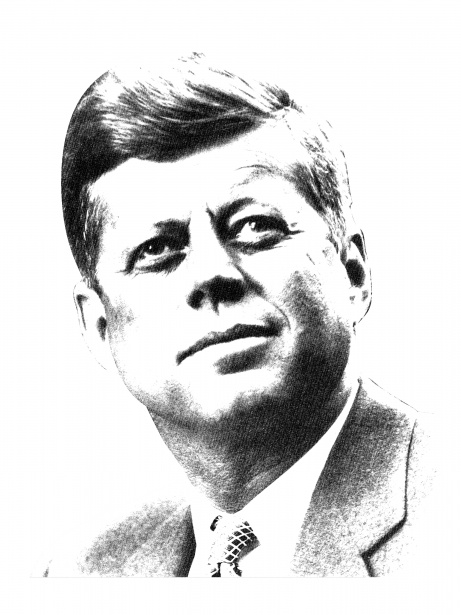
President John Fitzgerald Kennedy Assassinated 60 Years Ago Today

by H. B. Auld, Jr.

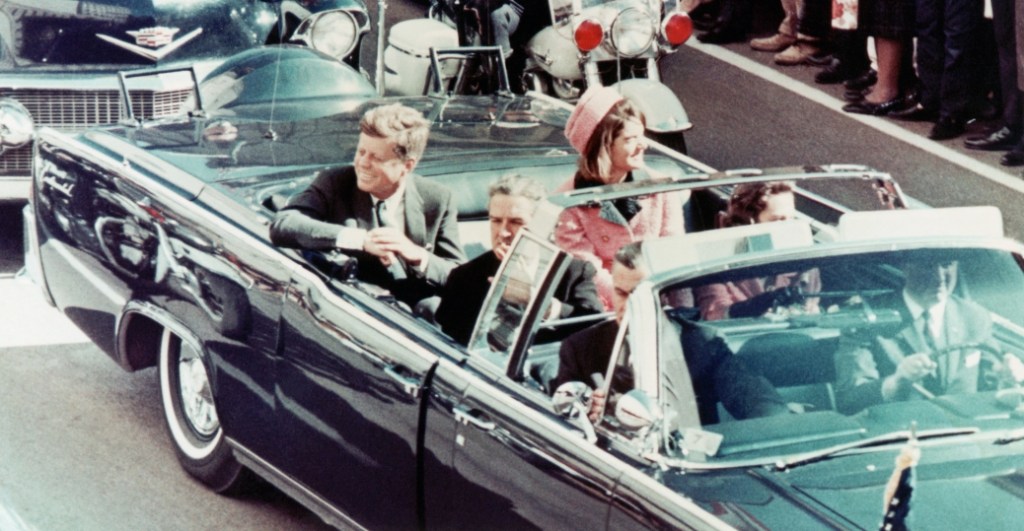
Sixty years ago today at approximately 1:00 p.m., CST, on Friday November 22, 1963, we lost our 35th President of the United States, President John F. Kennedy, to an assassin’s bullets.  He was shot shortly after noon, allegedly by Lee Harvey Oswald, as the presidential motorcade passed through Dealey Plaza in Dallas, Texas. 

President John Fitzgerald Kennedy and his wife of just 10 years, Jacqueline Kennedy, spent the previous night at the Texas Hotel in Fort Worth.  The following morning, President Kennedy, his wife, and a Texas delegation all exited the hotel to fly to Dallas.  A light rain was falling, but several thousand supporters were there to greet him and hear his brief remarks. 

“There are no faint hearts in Fort Worth,” he began, “and I appreciate your being here this morning. Mrs. Kennedy is organizing herself. It takes longer, but, of course, she looks better than we do when she does it.”  He continued his short speech, talking about a strong defense, space issues, and continuing the growing economy. 

The Presidential Party motorcaded to Carswell Air Force Base, where they flew to Love Field in Dallas, thirteen minutes away.  Arriving at Love Field, the President and First Lady went to the fence and greeted well-wishers, shaking several hands.

The rain stopped and the delegation decided to remove the plastic bubble top for the trip through Dallas to the Trade Mart where the President was scheduled to speak at a luncheon there. 

President Kennedy was struck in his neck and his head.

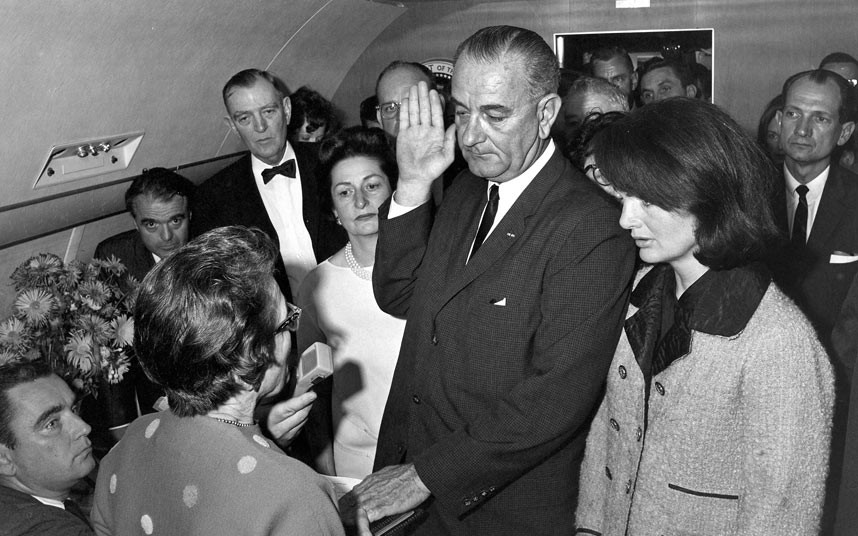
Making its way through Dallas, the motorcade turned from Main Street into Dealy Plaza.  As it drove past the Texas School Book Depository on their right, gunshots rang out.  President Kennedy was struck in his neck and his head.  He slumped toward his wife.  Texas Governor John Connally, a passenger in the President’s limousine, was struck by a bullet in his back.  The motorcade immediately sped away to the closest hospital, Parkland Memorial Hospital, which was just 12 minutes away.  Renowned surgeon, Dr. Robert N. McClelland, worked to revive the stricken president, to no avail.  A Catholic priest entered Trauma Room Three and administered the Last Rites to President Kennedy, who was pronounced dead at 1:00 p.m.  Vice-President Lyndon Baines Johnson, known to his friends as “LBJ,” assumed the presidency when Dallas Judge Sarah T. Hughes administered the Oath of Office aboard Air Force One as LBJ’s wife, Lady Bird Johnson, and JFK’s widow, Jacqueline Bouvier Kennedy, looked on.  Soon afterward, LBJ, the 36th President of the United States, flew back to Andrews Air Force Base in Maryland, with Air Force One carrying the body of President John F. Kennedy in a casket in the belly of the aircraft.

President John F. Kennedy’s accused assassin, Lee Harvey Oswald, was himself killed 48 hours later on Sunday as he was being transferred from police headquarters to the Dallas County Jail. 

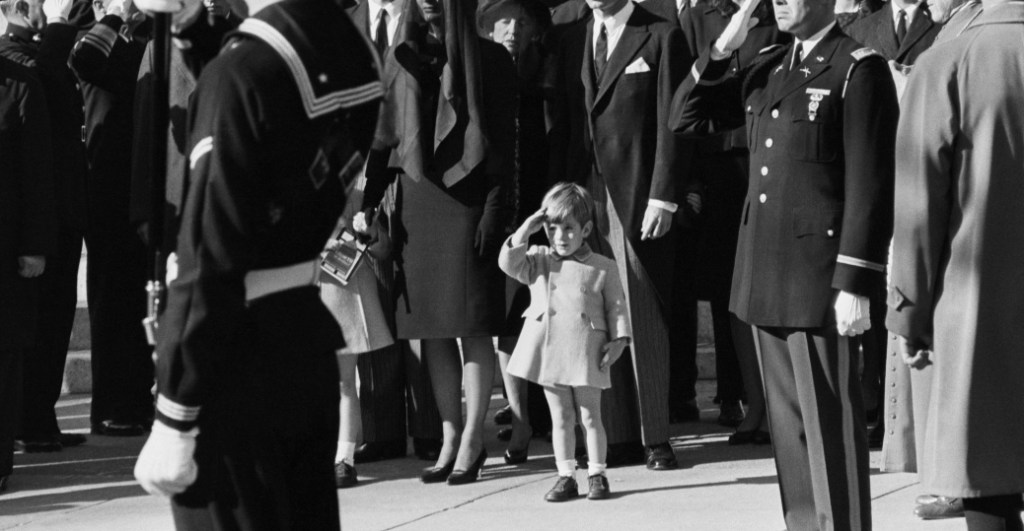
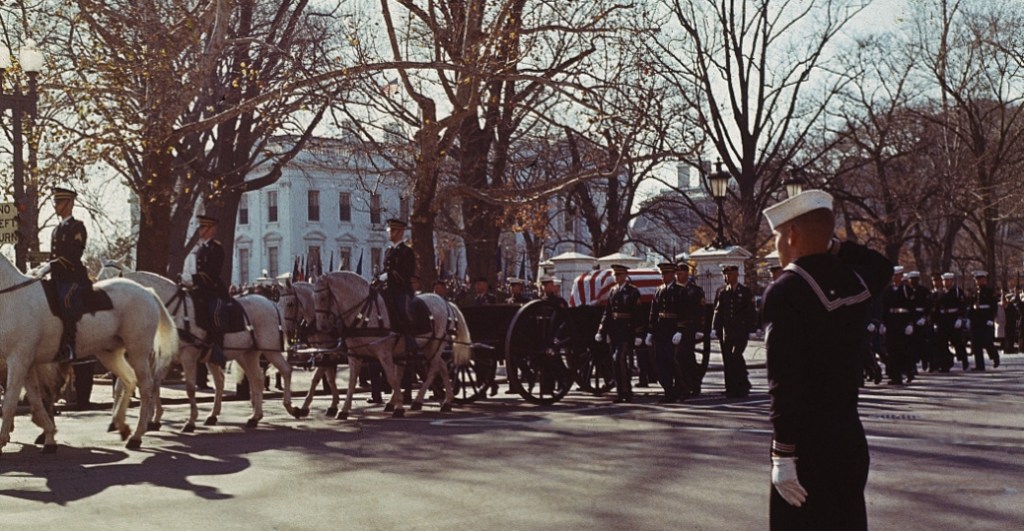
The late President John F. Kennedy was buried with full military honors at Arlington National Cemetery the next day, Monday, November 25, 1963.

The end of the John F. Kennedy Camelot Era brought with it a beginning of some darker times: more assassinations, including his brother Bobby and Dr. Martin Luther King, Jr; the Vietnam War; Watergate; a presidential resignation; 9/11; and more. But it also brought forth times in the sunlight: the Paris Peace Accord, the Ronald Reagan Presidency, the fall of the Berlin Wall, and much more.

Rest In Peace, John Fitzgerald Kennedy.

John F. Kennedy Would be a Republican If He Were Alive Today

by Larry Elder for Prager University

He was one of America’s most popular presidents — handsome, charismatic, a war hero. He believed a strong military was the best guarantor of peace; he explained that cutting taxes was the best way to grow the economy; he firmly opposed racial quotas, and was horrified by the idea of unrestricted abortions.

He was not a Republican

When he was elected president in 1960, Kennedy’s views were considered mainstream in the Democratic Party. But while the Kennedy name is still revered by the Democrats today, the policies he espoused are not.

Ronald Reagan, America’s 40th president, who was a Democrat much of his life, famously said, “I didn’t leave the Democratic Party. The party left me.”

So, if Kennedy were alive now, which party would he belong to? It’s impossible to know, of course. But we can compare his political positions to those of today’s Democratic Party.

On race:

JFK disliked the idea of using racial preferences and quotas to make up for historic racism and discrimination. Today, affirmative action is Democratic Party orthodoxy, but Kennedy thought such policies were counterproductive.

“I don’t think we can undo the past,” Kennedy said. “We have to do the best we can now…I don’t think quotas are a good idea…We are too mixed, this society of ours, to begin to divide ourselves on the basis of race or color.”

“A tax cut means higher family income and higher business profits.”

President John F. Kennedy

On taxes:

Kennedy was an ardent proponent of across-the-board tax cuts, believing that more cash in the hands of all Americans, including the so-called wealthy, and a lighter footprint from the IRS would grow the economy. “A tax cut means higher family income and higher business profits,” Kennedy said in an address to the nation shortly before his death. “Every taxpayer and his family will have more money left over after taxes for a new car, a new home, new conveniences, education and investment. Every businessman can keep a higher percentage of his profits in his cash register or put it to work expanding or improving his business.”

On foreign policy:

Kennedy was very firm about his red lines. When the Soviet Union built missile sites in Cuba, leading to what is known as the Cuban Missile Crisis, Kennedy threatened a decisive military response. The Soviet Union backed down. JFK believed, as Ronald Reagan did, in peace through strength, not strength through peace. In his inaugural address, Kennedy made the case for a strong U.S. military. He saw this as the only way to deter America’s enemies. “Only when our arms are sufficient beyond doubt,” he said, “can we be certain beyond doubt that they will never be employed.”

On gun rights:

Kennedy was one of eight U.S. presidents who was a lifetime member of the NRA. Here’s what he said about the Second Amendment: “We need a nation of minutemen – citizens who are not only prepared to take up arms, but citizens who regard the preservation of freedom as a basic purpose of their daily life, and who are willing to consciously work and sacrifice for that freedom.”

On abortion:

Kennedy was assassinated a decade before the landmark Supreme Court case Roe v. Wade. Abortion was not a major issue during his administration.

But we do know that he nominated Justice Byron White, a Democrat, to the Supreme Court. White was one of two justices who dissented in Roe v. Wade. We also know that Kennedy abhorred Japan’s post-WWII use of abortion as a means of population control, saying: “On the question of limiting population: As you know, the Japanese have been doing it very vigorously, through abortion, which I think would be repugnant to all Americans.”

Today, if a Democrat advocated the positions on race, taxes, foreign policy, guns and abortion that our 35th president once did, he wouldn’t be a Democrat. He’d belong to that other party.